In Brief
In 2026, the closure of the Strait of Hormuz moved from scenario planning to reality. The economic damage has to date been far less severe than anticipated, and the reasons are specific: buffers built deliberately after earlier crises. With the Strait closed again and those buffers more depleted than they were in February, it is important to recognise why the fallout was contained, what made that possible and what must now be built to hold the line.
In early 2026 Iran did what two generations of energy-security planners had assumed would never happen: it closed the Strait of Hormuz. For 15 weeks, the channel that carries roughly a fifth of the world’s oil and gas was shut to most shipping. The worst predictions – depression, rationing, $200 oil – did not materialise. The resumption of fighting and the second closure in mid-July show that the danger has not passed. Still, the first closure established something important: a shock of this size can be absorbed, and the buffers that made this possible can be identified, funded and strengthened.
Measured in terms of lost supply, the first closure was the most severe oil shock on record. At its peak more than 12 million barrels a day were taken off the market and traffic fell by over 90 per cent. Yet Brent peaked near $138 a barrel, above Goldman Sachs’s $135 risk case but well below the $150 and $200 closure scenarios, and by late June had returned to pre-war levels in the low $70 region. A smaller disruption in 1973 nearly quadrupled prices, but the 2026 crisis produced a peak rise of about two-thirds. The Federal Reserve Bank of Boston put the real shock at roughly one-third – enough to add about 1.5 percentage points to inflation but, overall, an impact less profound than expected.
This is because five main buffers cushioned the effects of the closure – and almost all of these were built in response to earlier failures: bypass pipelines built after the Iranian Revolution and Iran’s 2011 threats to close the Strait; the International Energy Agency (IEA) and its reserves established after the 1973 oil shock; China’s stocks; Iran’s own export dependence; and deep markets that priced the closure as temporary.
Yet these buffers have now been drawn down. By the mid-June ceasefire, reserves and workarounds may have been only three to four weeks from depletion. Under the International Monetary Fund’s (IMF) severe scenario, in which energy-supply disruptions extend into 2027, global growth would fall to 2 per cent in both years, around the level conventionally treated as a global recession.[_] The second closure is drawing on what buffers remain, from a weaker base. The IEA estimates that rebuilding depleted stocks would require about 1 million barrels a day of surplus supply for three years, on top of underlying demand growth.[_]
The lesson is not that the system is robust. It is that deliberate investments made decades ago have made this crisis survivable. The fallout from the first closure was smaller than expected because of policy, not luck. The resilience that held in 2026 was built by governments. Now, the Strait is shut again and these buffers will need to be reinforced.
The United States and its allies should treat building resilience against future shocks as a distinct soft-power objective. The capacity to keep the world’s energy, food and trade moving through a crisis is itself a source of influence, and the states that provide this capacity will strengthen their influence over those that rely on it. Building it deliberately, and extending it to exposed partners, is a practical way to strengthen alliances and reduce the leverage of those seeking to exploit disruption.
The measures that alleviated the recent crisis were physical and institutional: routes, reserves, production capacity and the bodies that coordinate them. The priority now is to build more of them, and to build them where the exposure is greatest. We recommend the following steps:
Open new sources of supply, in gas above all. Liquefied natural gas (LNG) can load from many coastlines rather than a few pipelines, so every new exporter reduces the grip of any chokepoint. Gas had no coordinated strategic reserve and no route around Hormuz in 2026.
Build fertiliser and processing capacity where import dependence is deepest. Sub-Saharan Africa imports about 90 per cent of its mineral fertiliser, much of it from the Gulf, and the closure hit food security before it hit fuel bills.
Expand bypass routes and pre-position the maritime capability – mine-clearing and escort – which restores passage in weeks rather than months.
Deepen and share reserves, bringing China and India into a coordinated release mechanism rather than leaving competing stockpiles to work against each other.
Extend the same buffers to import-dependent economies that cannot finance them alone, through multilateral banks.
Make chokepoint exposure visible, so firms and governments can price the risk before a closure reveals it.
These are not radical ideas. They represent the same type of investment in resilience that led to the Strategic Petroleum Reserve (SPR), the IEA, Petroline and the North Sea development – investment which would be deepened and extended to those countries that remain exposed. The world survived the first closure on cover bought decades ago. The second closure is being fought with less of it – making the case for action more urgent.
Chapter 1
The geographic importance of the Strait of Hormuz is considerable: some 20 million barrels of oil a day pass through shipping lanes just 2 miles wide. This represents a fifth of global consumption and over a quarter of seaborne oil trade, alongside close to a fifth of the world’s LNG, with five of every six barrels bound for Asia. The risk was never that Iran could keep the Strait shut indefinitely, given the presence of the US Fifth Fleet, its own export dependence and China’s stake. The danger was that even a short closure would transmit rapidly through crude, gas, shipping, insurance, fertiliser and food, leading to inflation. Confronted with a war it saw as existential, Iran crossed a threshold that had remained intact through earlier crises.
The scale of the disruption was without precedent. At its peak, more than 12 million barrels a day were off the market and traffic through the Strait fell by more than 90 per cent, a larger and faster loss of supply than the crises of the 1970s produced. The bypass pipelines carried what they could, about 5.7 million barrels a day, and with the volumes still moving through the Strait total Gulf exports ran near 7.9 million against the 20 million Hormuz normally carries (see Figure 1), which left a shortfall no alternative route or reserve could fully make up. However, prices moved far less than the arithmetic implied (Figure 2).
Bypass pipelines preserved some of the region’s export capacity
Sources: IEA, JPMorgan, Brookings Institution, Goldman Sachs, Morgan Stanley, Reuters, TBI analysis
Brent peaked below the spike and severe closure scenarios
Sources: US Energy Information Administration via FRED, Goldman Sachs, Citi, Wood Mackenzie
Note: Daily Europe Brent spot price, dollars per barrel, not seasonally adjusted (Crude Oil Prices: Brent – Europe [DCOILBRENTEU], retrieved from FRED, Federal Reserve Bank of St. Louis). Forecasts: Goldman Sachs, March 2026; Citi, April 2026; Wood Mackenzie, Strait Talking: Iran War Scenarios and the Future of Energy, Horizons, 20 May 2026.
The effect on the wider economy is the clearest measure of containment. Before the war, the IMF expected global growth of 3.3 per cent in 2026. Its July update puts it at 3 per cent, so the largest supply disruption on record has cost the world economy roughly three-tenths of a percentage point of growth, against the 2 per cent recession-threshold outcome the IMF modelled for a conflict running into 2027.[_] Compared with the 1973 oil embargo, when a smaller disruption led to a global recession and a decade of stagflation, the current situation is far less severe – and explaining that achievement is the purpose of this paper.
The inflation picture is less reassuring, and this is where the containment is weakest. Global headline inflation has been revised up to 4.7 per cent for 2026, and the IMF is explicit that the disinflation under way since early 2024 has stalled. The revision is not a one-off adjustment to a spike but the consequence of a lasting shock that has persisted, with the pass-through widening from energy prices into food and fertiliser costs. The July baseline now sits more closely aligned with what the April forecast had described as its adverse path. Growth was protected; prices were not.
The containment was real but only partial. The gap matters more. Oil was buffered. Everything downstream of gas was not. Fertiliser prices rose by roughly 80 to 100 per cent heading into the northern spring planting season, because natural gas is the main feedstock for nitrogen fertiliser, and a gas-price shock passes almost directly into ammonia and urea, and from there into food within a single growing season. Aluminium and steel, including the reinforcement bars construction depends on, need continuous power and gas, and idled smelters are slow and costly to restart. The reserves and spare shipping that cushioned crude did nothing for these gas-dependent sectors, because no equivalent buffer exists. That asymmetry – a well-insured oil system sitting alongside an uninsured gas system – explains why the same closure appeared in advanced economies as a manageable rise in oil prices and in South Asia as fertiliser plants shutting down and schools closing (see Chapter 2).
The qualification for all this is that the first closure was bounded. It lasted 15 weeks and ended in an interim agreement. The Strait closed again in mid-July under a reinstated blockade and fresh tanker attacks, and the buffers are being drawn a second time from a lower base. Markets have repeated the spring pattern: Brent has swung between the high $70s and low $90s through July as strikes on Gulf energy infrastructure have alternated with brief diplomatic openings. If this closure runs into the autumn without a settlement, the containment described in this chapter cannot be assumed to hold.
Chapter 2
The integrated system, hardened by crises from the 1973 oil embargo to the 2022 Russia–Ukraine war, absorbs shocks better than it once did. The milder-than-expected disruption came down to five buffers, and nearly all exist because an earlier crisis exposed their absence.
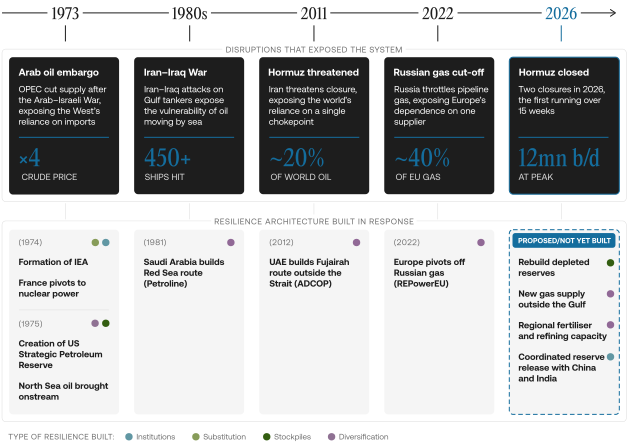
The 1973 shock produced the modern architecture of energy security: the United States created the SPR; consuming states founded the IEA; France launched the Messmer Plan and turned to nuclear power; Britain and Norway accelerated North Sea development. Saudi Arabia built Petroline, completed in 1981, after the Iranian Revolution exposed the Strait as a single point of failure, and the tanker war that followed vindicated the decision; the 2011 Iranian threats brought the United Arab Emirates’ Fujairah pipeline (Figure 3). Each was an expensive investment in insurance, each was built with no crisis in view and each played its role in managing the fallout in 2026 in a way nothing else could have done.
Energy-security shocks since 1973 and the resilience architecture built afterwards – new institutions, stockpiles, routes or diversification
Source: TBI analysis
Five buffers absorbed the first closure. Of these, one has proved durable and four were temporary:
Durable
Alternative export infrastructure. Saudi Arabia’s Petroline to the Red Sea moved 5 million barrels a day before the war and was pushed towards 7 million; the UAE’s line to Fujairah carries up to 1.8 million. This buffer outlasts the emergency but is not a full substitute: combined bypass capacity is close to 8 million barrels a day, compared to the 20 million Hormuz carries, and the pipelines move crude, not the gas alongside it.
Temporary
Iran’s own dependence. With around 90 per cent of its exports bound for China, Iran’s reliance on the Strait limited how far it could escalate; a prolonged shutdown would have cut the revenue it depends on. The July reclosure does not invalidate that logic, but it does expose its limits. The constraint applies only while Iran has volumes worth protecting, and with flows already throttled by war damage and interdiction, closing the Strait now costs Tehran less.
The IEA reserve release. The IEA coordinated the largest oil-reserve release in its history: 400 million barrels. It added supply when private inventories were most depleted, but drawn stocks cannot be replaced mid-crisis, so this only bought weeks, not a durable cushion.
Chinese strategic stocks. China met the shortfall largely by drawing on commercial stocks and cutting refinery runs rather than releasing its national strategic reserve, cushioning the largest single buyer of Hormuz crude while barely touching its emergency stockpile. Its combined commercial and strategic inventories stood near 1.2 billion barrels when the war began, but the commercial draw ran at roughly a million barrels a day and could not continue indefinitely.
Market depth. Deep, liquid markets priced the closure as severe but temporary, and reallocated cargoes and risk quickly. But that pricing holds only while traders expect the Strait to reopen and would erode if a closure outlasted the capacity of physical buffers to absorb it.
Two of the five buffers came from market integration; the other three were state-built insurance funded years before they were needed. Markets gave flexibility, but the capacity to absorb a shock this size came from cover paid for in advance.
That distinction illustrates the limits of markets acting alone. Buffers are insurance: costly to hold, valuable only in the event of a severe shock and therefore underprovided by firms that would be undercut by competitors who carry none. Every buffer that mattered in 2026 was financed by a government or an institution built by governments years or decades before the crisis and sustained across administrations with no emergency in sight. That is this paper’s central finding, and it underpins the public-investment agenda set out in Chapter 3.
Having the infrastructure does not help if the will to use it is missing. Iraq illustrates this. Its overland bypass to the Mediterranean, the Kirkuk-Ceyhan pipeline, sat largely idle for more than two years after a 2023 arbitration ruling and an unresolved dispute between Baghdad, the Kurdistan Regional Government and Ankara. When the Strait closed and southern exports through Basra collapsed, Iraq scrambled the line back into service, yet it carried only about 250,000 barrels a day, a fraction of its capacity. Saudi Arabia and the UAE, by contrast, had built and maintained their bypasses, and both kept much of their exports flowing. The infrastructure existed; what was missing was the institutional will to keep it usable.
Diversification also strengthened resilience, but the key factor is whether countries diversified energy sources or just suppliers and routes. Done badly, diversification simply relocates the vulnerability. France’s post-1973 nuclear programme is the classic case, but China is the recent example. A decade of investment in nuclear and solar power, electrified transport and battery manufacturing has cut the share of its economy that relies on any single imported fuel – one reason it proved less exposed than its role as the largest buyer of Hormuz oil suggests. Germany is the counterexample: it cut some oil dependence while deepening reliance on Russian gas. Losing that gas after the Ukraine invasion proved costly – it had swapped one dominant dependency for another.
Comparing recent events to earlier shocks shows what has been achieved: a smaller disruption in 1973 nearly quadrupled prices, while 2026 produced a peak rise of about two-thirds. The buffers also came close to running out, which is what makes the agenda we set out urgent rather than merely sensible. By the June interim agreement, inventories and emergency stocks ran leaner than in past decades. Russian floating stocks would likely have been exhausted by the end of April and Iranian stocks by the end of May, with coordinated reserves depleting by around 9 July, according to Brookings. Beyond that, the system faced an unbuffered shortfall of nearly 7 million barrels a day, about one-sixth of seaborne crude, that no pipeline or reserve could replace. The settlement came perhaps three to four weeks short of that point.[_]
Each buffer runs on a different clock, and the order in which they give way shapes how prices move over the course of a closure. The pipelines are a fixed ceiling from day one; the reserves are a stock, not a flow, adding weeks but impossible to refill mid-crisis; and market pricing is the most fragile, holding only while traders anticipate the Strait reopening. The dangerous inflection is where the physical buffers empty and the market stops treating the closure as temporary; past this, the forecasts that failed to arrive in 2026 – Wood Mackenzie’s $200 and Citi’s $150 – stop reading as alarmist and become plausible outcomes. That point is closer now than in the spring.
The recent Hormuz disruption has not matched 1970s repricing, with the closure peaking at around 65 per cent above baseline
Source: FRED
Note: 1973–74 and 1978–80 use monthly spliced WTI (WTISPLC); 1987 onwards use monthly Brent-Europe (MCOILBRENTEU), both USD/barrel and not seasonally adjusted. Tanker war is a shipping-risk comparator, not a sustained barrels-offline shock. The 2026 line is incomplete after June 2026; daily Brent showed a sharper intramonth peak and faster late-June reversal.
The final lesson is that the buffers did not protect all countries equally. Most of the buffers that worked protected a narrow set of economies: the United States, IEA members, Norway, France and major Gulf producers. The IEA is a club of advanced economies and its reserve release, the single largest temporary buffer, was available only to its members. The economies that took the greatest strain, several of them in the high-risk quadrant of Figure 5 and together home to around half a billion people, had no comparable insurance, and what happened to them is a matter of record rather than inference.[_]
The most exposed importers pair heavy reliance on Hormuz with weaker external balances
Sources: US EIA, World Bank, IEA, UNCTAD, OEC, Eurostat, TBI analysis
Note: Bubble size denotes population size
Bangladesh, the world’s eighth most-populous country, expected 115 LNG cargoes in 2026 and projected losing 40 of them. Spot cargoes it bought in January at about $10 per million British thermal units cost $28.28 by mid-March, and an initial tender on 1 March drew no bids at all because traders judged the market too risky. The government diverted gas to power generation and shut four of its five state-run urea fertiliser plants for at least a fortnight in the middle of the Boro rice season, when paddies need consistent fertilisation. Universities closed and fuel sales were limited. Pakistan, which began the year with an LNG surplus, received 12 cargoes in January and two in March. It suspended LNG supply to its fertiliser sector, closed schools and universities, and cut regasification rates. Qatar supplies roughly 90 per cent of Pakistan’s LNG, and long-term contracts signed precisely to avoid spot-market volatility delivered nothing once QatarEnergy declared force majeure.[_]
The pattern in both cases is the same. These states had no reserve to draw on, no alternative supply route and no institution to coordinate a release on their behalf. They substituted the only buffer available to them, which was rationing: gas taken from fertiliser plants and given to power stations, schools closed to cut load, fuel sales capped. That is what an absence of resilience looks like in practice – transforming an energy shock into a food and education shock within weeks. A system that shields the wealthiest while leaving the most exposed to rationing is incomplete and unstable: fuel, food and balance-of-payments crises in exposed states rapidly become regional and global risks.
Chapter 3
The goal now for global policymakers is to reduce the systemic weight of any single closure. For four decades the answer to Hormuz was deterrence, backed by the ability to force open the Strait if deterrence failed. The limits of that approach have been exposed. When the channel reopened in June, only about 10 per cent of marine traffic returned before it closed again in July, held back by mines and the risk of renewed fighting. Iran has shown that a temporary closure can be an effective instrument of coercion despite the costs it imposes on the perpetrator – a lesson that extends beyond Hormuz. The objective is no longer only to reopen the Strait in a crisis; it is to make its closure, and that of other chokepoints, matter less (see Figure 6).[_]
Planned and potential energy infrastructure that would reduce reliance on the Strait of Hormuz
Sources: The Institute for Energy Research, Reuters, Arabian Gulf Business Insight, Gulf International Forum, IPIS, Qatar Fund for Development, Brookings, TBI analysis. Note: West-East 1 pipeline runs alongside the existing Abu Dhabi crude oil pipeline, which has a capacity of 1.8mn barrels per day.
The measures that follow are structural rather than institutional: production capacity, routes, processing plants, storage, ships. The buffers that worked in 2026 were physical assets together with the institutions that financed them, and the fastest returns now come from adding to that stock rather than creating new governance for it.
They are not of equal urgency, and the costs differ by orders of magnitude, so a government with finite capital should address them in order of priority. Three measures should start now. Rebuilding the drawn reserves is the first call, because it restores the buffer that did most work in the first closure and is the most depleted going into the second. The US Department of Energy costed a full refill of the SPR at about $20 billion for roughly 300 million barrels, with a further $100 million for site repairs. Pre-positioning mine-countermeasure and escort capability is cheaper: the Belgian and Dutch replacement programme is buying 12 vessels for about €2 billion, some €167 million each, and the unmanned mine-hunting systems they carry cost single-digit millions. Mines and the risk of renewed fighting kept traffic at a tenth of normal volume after the channel formally reopened in June, so this is the capability that most directly shortens a closure. Chokepoint-exposure disclosure is the cheapest measure in this paper and needs no treaty at all.[_]
Two measures belong in the next three to five years, because they are capital projects with long lead times and require investment on a different scale: new gas supply outside the Gulf, where a single liquefaction train runs to several billion dollars, and fertiliser and refining capacity in the regions that import most, where the expansion of Nigeria’s Dangote fertiliser complex alone is a $7 billion programme. Neither is financeable from a resilience budget; both need the development banks and sovereign investors described below, which is why the case for treating this capacity as infrastructure rather than industrial policy matters. One measure costs almost nothing and is the hardest of all: bringing China and India into a coordinated reserve release mechanism is a decade-long political undertaking rather than an investment. It is the highest-value initiative here and depends more on diplomacy, which is why it should be started earliest and expected to finish last.
Open New Sources of Supply
Gas is the strongest case for opening new sources of supply, because it is where 2026 exposed the greatest vulnerability. Oil had reserves, bypass pipelines and a coordinating institution. Gas had none of these: no strategic-reserve system, no route around Hormuz and close to a fifth of the world’s LNG passing through the Strait. The remedy is on the supply side and it is already partly underway. LNG is loaded onto carriers from many coastlines rather than from a few fixed pipelines, so every new export source that reaches the market loosens the grip any single chokepoint holds.
Gas supply was also damaged in a way that oil escaped, and the ramifications will outlast this crisis. Iranian strikes on Ras Laffan, Qatar, in March destroyed two liquefaction trains accounting for 12.8 million tonnes a year, about 17 per cent of Qatar’s export capacity. QatarEnergy expects this to take three to five years to repair and has forced long-term force majeure on contracts to buyers in China, South Korea, Italy and Belgium. Reopening the Strait does not restore that capacity. It is the clearest argument in this paper for building supply outside the chokepoint rather than planning only for its reopening: a closed strait lasts for the duration of a conflict, but a destroyed train can take five years to replace, and long-term contracts through a contested waterway proved to be no substitute for physical diversity of supply.
Mozambique holds some of this century’s largest offshore gas discoveries, and further finds continue to be made elsewhere in Africa and beyond. Bringing that gas into production, alongside expanded supply from the United States, Qatar and Australia, expands the world’s options and shortens the list of buyers with nowhere else to go. The constraint is rarely geology; it is the patient capital, the security guarantees and the permitting timelines needed to turn a discovery into a cargo. This is precisely the kind of long-horizon investment that governments and development finance institutions exist to de-risk. The same argument applies to oil production outside the Gulf – from American shale to the North Sea – which cuts the share of world supply hostage to one strait.
Build Processing Capacity Where the Dependence Is Deepest
Fertiliser deserves particular attention, because it is where a chokepoint closure does its most direct human damage and where the structural remedy is clearest. Natural gas is the main feedstock for nitrogen fertiliser. The Gulf accounts for roughly a third of globally traded fertiliser, so the Hormuz closure is simultaneously an energy shock and a food shock. In 2026 fertiliser prices rose by roughly 80 to 100 per cent into the northern planting season, and the World Bank noted that urea prices could exceed the 2022 average of $700 a tonne, the second-highest level in real terms since 1974.[_]
Sub-Saharan Africa is the most exposed region to disruption, importing about 90 per cent of its mineral fertiliser. That dependence is a policy choice, rather than a natural condition, and is beginning to be reversed. Nigeria has moved from importing most of its fertiliser to exporting it: urea exports rose from 660,000 tonnes in 2017 to more than 3 million in 2024, and the Dangote complex at Ibeju-Lekki, already one of the largest granulated urea plants in the world, is being expanded from 3 million tonnes a year towards 9 million tonnes, with a further 3-million-tonne plant planned in Ethiopia. Morocco’s OCP, which holds the world’s largest phosphate reserves, is raising plant-nutrient capacity from 15 million tonnes towards 20 million and has committed 4 million tonnes to African markets, alongside a green-ammonia programme intended to replace the ammonia it currently imports. Indorama is commissioning a third urea line in Nigeria with African Development Bank support.
The strategic logic that created the SPR should now be applied to food. A continent that makes its own nitrogen is insulated from a Gulf chokepoint in a way no reserve release can achieve, because fertiliser has no IEA and no stockpile to draw on. OCP’s plant in Nigeria’s gas-rich Akwa Ibom State is the clearest illustration, pairing Moroccan phosphate with Nigerian gas into a supply chain that never passes through Hormuz. Getting to self-sufficiency needs capital at a scale and over a timeframe that private markets will not supply alone. That is the case for development banks and sovereign investors to fund fertiliser capacity as strategic infrastructure, in the same category as ports and power grids, rather than as agricultural development spending.
The same principle extends to refining. Nigeria now produces close to a fifth of Africa’s petrol and has begun supplying import-dependent neighbours, cushioning part of the regional impact of the 2026 shock. Regional processing turns a global price shock into a manageable one. A country that imports finished fuel is exposed twice, to the crude price and to the refining margin, and in a crisis both rise together. A country that refines its own crude is exposed only to the first, and its neighbours can buy from a supplier a few hundred miles away rather than one on the far side of a contested waterway.
Expand Routes and the Capability to Keep Them Open
The pipelines that supported the system through the first closure show the value of physical redundancy. More can be built with capital already available. Priority should go to routes that also ease dependence on the southern Red Sea, since crude redirected west out of the Gulf still passes Bab al-Mandeb, where Iran-aligned Houthi forces can open a second point of pressure. This is the measure that most directly shrinks the shortfall a closure imposes.
Physical routes are only as good as the ability to keep them usable. Mine-countermeasure vessels, standing convoy plans, marine surveillance and safe-passage protocols are modest by the standards of defence budgets and far cheaper to hold ready than to improvise under fire. The purpose is not to guarantee that every ship moves in all conditions but to shorten the time needed to restore safe passage, reassure insurers and prevent a security incident becoming a commercial shutdown. Mines and the risk of renewed fighting were what kept traffic at a tenth of normal levels after the channel formally reopened in June. These capabilities should be built and exercised before the next closure, not assembled during it.
Deepen and Share the Reserves
Reserves did more than any other temporary buffer to alleviate the first closure and are the most depleted going into the second closure. Rebuilding them should be the first priority for any resilience budget. Beyond replacement, the gap worth closing is coordination. China’s and India’s strategic reserves took on outsize weight in 2026, yet remain outside the IEA’s emergency-release framework, which remains a club of advanced economies. Bringing the major Asian consumers into a coordinated release mechanism, either through IEA reform or a parallel body where they have genuine standing, would convert competing stockpiles into a shared response. It is the hardest element in this paper, because it is political rather than financial, and credible only as an inclusive arrangement.
The reserve model should also be extended to gas, which had nothing comparable in 2026. Strategic gas storage is more expensive and technically harder than oil stockpiling, but the 2022 European experience and the 2026 closure both point the same way: the fuel with no buffer is the one that impacts most quickly on fertiliser, food and power prices.
Extend the Umbrella to Those Who Cannot Build It Alone
Many import-dependent economies lack the fiscal space to build strategic buffers, alternative routes or the institutions to run them, and these are the economies where a closure does the worst damage. Multilateral development banks should treat chokepoint resilience as a global public good and finance it directly: reserves and emergency storage, port and logistics resilience, fertiliser and refining capacity, and the pooled mechanisms that let smaller economies buy into reserves and alternative routes they could not finance alone. This money buys the wider stability their shareholders benefit from and addresses the unequal distribution of resilience identified in Chapter 2.
Make Exposure Visible
Currently, there are no standards requiring firms to disclose their dependence on any single chokepoint, which means the exposure sits unmeasured and mispriced until a crisis reveals it. A chokepoint-exposure disclosure standard, modelled on the climate and nature frameworks markets have already absorbed, would make large importers and traders report their reliance on each critical strait. It needs no treaty, it is cheap and it changes behaviour by making risks visible to boards and insurers before, rather than after, a closure. It is also the precondition for any future financial architecture: insurance instruments, shared funds and standing facilities all depend on the ability to measure exposure first.
There is a case, which this paper does not develop, for a standing financial mechanism to fund these buffers: a resilience fund with the long-term investment horizon of a sovereign wealth fund, an insurance backstop that activates when private war-risk cover withdraws and a peacetime charge on traffic through chokepoints to help fund them. The questions around who administers such a mechanism, under what authority and on what legal basis are substantial enough to merit separate treatment. Nothing in the structural agenda above depends on resolving them.
Chapter 4
For two generations the central question around Hormuz has been how to keep it open. That remains essential but is no longer sufficient. The disruption in 2026 has shown that the Strait can be closed and a severe closure absorbed for a short time, but only because governments, companies and institutions financed the buffers in advance. The economic fallout has been smaller than feared because of choices made after 1973, after the Iranian Revolution, after 2011 and after 2022. Nothing in this year’s outcome was luck, and neither was it the market working alone.
That is the finding with the most uncomfortable implication. The buffers were bought by an earlier generation of policymakers who paid for insurance they would never see used and could claim no credit for, and those buffers have now largely been exhausted. The margin was three to four weeks. The reserves that provided cushioning cannot be rebuilt during a closure, the trains destroyed at Ras Laffan will take up to five years to replace and the second closure is running on what is left. A system that survives on inherited insurance and does not replace it is not resilient; it is living off capital.
The next layer of resilience architecture will be built, just as earlier layers were, after this crisis or the next. The key question is whether it is built deliberately, extending protection beyond the wealthiest and best-insured states, or whether the world waits for the shock that finds the buffers empty. The measures set out here are neither novel nor expensive when compared with the cost of a prolonged disruption: investment in reserves, routes, mine-clearing ships, fertiliser plants and the institutions to hold them. They require choices as consequential as those taken in 1974, and this crisis has demonstrated why they should be made now. For the United States and its allies there is a strategic prize in taking them first: the country that builds resilience, and helps others share in it, turns a vulnerability into a source of influence.
None of it will reopen the Strait this summer. That is precisely the argument for beginning now. The buffers that carried the world through the first closure were paid for decades in advance by governments that never saw them used. The second closure is being fought with what is left of them. Whether anything remains for what comes next depends on decisions taken while this one is still running.