The world is, in President Xi Jinping’s own words, “undergoing great changes unseen in a century”.[_]
The challenge for China’s 15th Five-Year Plan will be ensuring that China places itself firmly on the right side of those “great changes”.
In the eyes of China’s decision-makers, the country is entering a decisive period: the pace of technological and geopolitical disruption requires every lever of state policy be aligned to secure China’s position.
The new Plan, due to be adopted in early March, will double down on the direction of travel of the 14th Five-Year Plan, which put resilience and indigenous innovation at the centre of China’s national strategy. Both the successes and the strains of the past five years have cemented that viewpoint: China’s dominance over upstream rare-earth supply chains has allowed it to successfully push back against US trade and tech pressures, but continued reliance on foreign chipmaking inputs is complicating progress at the highest-value end of the technology stack.
The new Five-Year Plan will be first and foremost a domestic-policy blueprint. But its implications are far-reaching: ambitions for world-leading manufacturing and supply-chain capabilities will reshape competitive dynamics for advanced and emerging economies alike, while an all-out focus on AI deployment could redefine the terms of technological competition.
And the Plan’s level of success in addressing domestic challenges, in particular delivering an ambitious transition to innovation-driven growth, will determine Beijing’s appetite for risk in asserting its interests beyond China’s borders.
Ahead of the Plan’s formal adoption in early March, this paper draws on the Communist Party of China (CPC) Central Committee’s “Recommendations” for the 15th Five-Year Plan, authoritative Party guidance on political framing and policy priorities released late last year. Through comparative analysis of the 2020[_] and 2025[_] “Recommendations”, as well as broader insight from one of the liveliest policy-making processes in the Chinese political cycle, this paper previews what will – and won’t – change in China’s strategy over the next five years.
1. Sci-tech: Diffusion, not development, will take the top-priority spot in the 15th Five-Year Plan.
We expect “industrial upgrading” – efforts to deploy AI and other emerging technologies across industry – to be the Plan’s top priority as focus moves from developing China’s sci-tech base to translating technological advances into material gain.
Beijing is not looking to shed lower-value industries as it develops: leadership wants to produce the world’s most competitive robots and the world’s most competitive consumer goods. AI-enabled manufacturing dominance aims both to shield China from US-led pressures and counter internal demographic pressures – the goal is not to “get rich before China gets old”, but get rich even as China gets old.
This all-out manufacturing push will be doubly disruptive, increasing pressure on manufacturing-heavy emerging economies and reshaping views of AI competition: Beijing is rejecting a US-style frontier “race” in favour of deployment at scale.
2. Foreign policy: China will build out its offer for countries that support it and raise costs for those that don’t.
The new Five-Year Plan will outline a significantly more confident diplomatic posture: Beijing is upgrading from “actively participat[ing] in” to “lead[ing]” the international order and increasingly centring homegrown diplomatic frameworks.
It will also invest more heavily in better understanding – and persuading – foreign audiences. A new section on “extending the reach and appeal of Chinese civilisation” calls for deeper regional expertise and more “innovative” communication methods.
Beijing is simultaneously building out its economic statecraft capabilities. New language on the extraterritorial defence of China’s interests and “step[ping] up our fight against foreign sanctions, interference, and long-arm jurisdiction” signal a growing user of targeted trade, legal and export-control instruments to ensure diplomatic alignment.
3. Trade and investment: Foreign firms will have to navigate an increasingly selective approach to “opening up”.
The biggest jump in priorities between 2020 and 2025 is “high-level opening up” (which moved from number 9 to number 5). But this sits alongside intensified efforts to reduce China’s external vulnerabilities: global dependencies on China are acceptable, Chinese over-dependencies on critical foreign inputs are not.
Moves towards “national treatment” for foreign firms are likely to be uneven. Opportunities are increasingly sector- or region-specific, for example in the services sector or designated regions like the Hainan Free Trade Zone.
“Institutional opening up” will also feature prominently as China aligns closer with international trade and regulatory rules. This will improve predictability for foreign firms but will also support the internationalisation of Chinese firms seeking access to new markets.
4. Tackling “involution”: New structural reforms are a response to domestic dynamics, not international overcapacity concerns.
The Plan will set out China’s most ambitious efforts yet to tackle interprovincial competition and ensure that poor horizontal coordination doesn’t derail sci-tech ambitions.
Beijing wants high-tech capabilities developed “in line with local conditions”, with provinces playing to comparative strengths, not “blindly” chasing central priorities. More detailed plans for a “national unified market”, VAT reform trials and tighter “regulation” of local subsidies all aim to improve centre–local efficiency.
Crucially, this “anti-involution” push is domestically driven, not a direct response to international overcapacity concerns. Beijing’s priority is sustainable tax bases and efficient technological gains – higher levels of waste will still be tolerated in geo-strategically important next-gen technologies.
5. Futureproofing China’s talent base: Beijing is raising technical and political standards to ensure competitiveness.
Cultivating China’s sci-tech talent base has been elevated to a national strategic priority in its own right and the Plan will reiterate calls for immigration pathways for foreign sci-tech talent.
Beijing also wants the right enabling political environment for boosting innovation. Officials are increasingly expected to be “red and expert”, with a STEM or finance background an increasingly strong predictor of political progression.
Political standards are also rising. The Plan will encourage stronger demotion mechanisms for poor performance and ensure that “political commitment [is] the primary criterion” in appointments as disciplinary campaigns intensify.
Chapter 1
Five-Year Plans provide China’s foundational policy scaffolding, setting out priorities and performance benchmarks across virtually all major areas of social, economic and international policy.
Initially the backbone of China’s planned economy, Five-Year Plans now function more as high-level roadmaps: although the English translation has remained unchanged, the Chinese term for “plan” shifted from jihua (计划) to guihua (规划) in 2006, signalling a shift from prescription to guidance.
Plans are a cross-state coordination tool, allowing central leadership to articulate overall policy direction and signal the relative importance of priorities. From here, individual government departments and provinces produce their own Five-Year Plans, creating a policy ecosystem that cascades central priorities throughout the state apparatus.
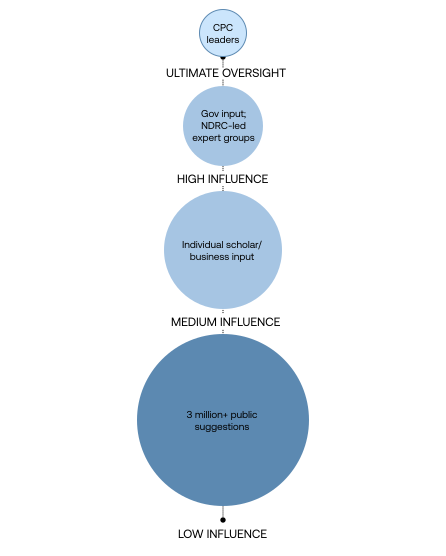
Drafting a plan on this scale is an extremely labour-intensive process: preparations begin at least two years in advance. But as the document is primarily a socioeconomic one, rather than political, the process also brings in a remarkably broad range of stakeholders: academics, businesses and, ahead of the 15th Five-Year Plan, more than 3 million public suggestions. That makes it one of the most valuable places to monitor Chinese policy debates.
A broad range of stakeholders contribute to the development of a Five-Year Plan
Source: TBI analysis
Note: NDRC stands for National Development and Reform Commission.
Five-Year Plans also tend to be bound by existing policy goals, ensuring continuity across planning cycles. The upcoming 15th Five-Year Plan (2026 to 2030), for example, will have to ensure the implementation of more than 300 reform measures[_] ahead of the 80th anniversary of the People’s Republic of China (PRC) in 2029, ensure that China hits its 2030 carbon-peaking goal and serve as a stepping stone towards China’s 2035 goal of “basically achieving socialist modernisation”.[_]
Ultimate oversight, however, lies with CPC leadership. Although Five-Year Plans are adopted at the annual session of the National People’s Congress, a state event, Party leadership is involved throughout the years-long drafting process. And it’s the Central Committee’s “Recommendations”, usually published following a Fifth Plenum,[_] that provide the most authoritative preview of the final product.
Chapter 2
The previous 14th Five-Year Plan (2021 to 2025) marked a significant evolution in how Beijing assessed the external environment.
Both the pandemic and the trade and technology controls imposed during President Trump’s first term disrupted earlier assumptions of a relatively stable international landscape in which mutual interdependence would be broadly beneficial to China.
In response, the 14th Five-Year Plan placed significantly greater emphasis on resilience building and indigenous innovation, with Beijing willing to accept slower but “high-quality” growth as the price of reduced vulnerability to external shocks. Explicit multi-year GDP targets were scrapped,[_] and “dual circulation” – the idea that domestic demand should lead growth, supported by selective external engagement – was elevated to a central organising policy principle.
The past five years have, in the eyes of leadership, vindicated that viewpoint. China’s export machine has shown remarkable resilience to US tariffs – overall exports are up 5.5 per cent year-on-year,[_] despite a 20 per cent drop in imports to the US – while China’s dominance in rare-earth supply chains has allowed it to wield powerful asymmetric leverage. In other words, efforts to ensure the world is more dependent on China than China is on the world are paying off.
Domestically, China’s sci-tech drive has produced high-profile instances of indigenous innovation, most notably DeepSeek’s R1 model – reinforcing a cautious confidence in leadership that near-term pain points, such as youth unemployment and the real-estate downturn, are manageable as part of a difficult but deliberate transition towards innovation-led growth.
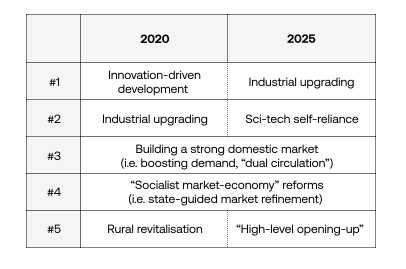
The 15th Five-Year Plan will lay out the next step of this transition. Topline priorities are likely to remain broadly similar to those listed in the 14th Five-Year Plan, focusing on innovative capacity, industrial upgrading and strengthening the domestic market.
Top priorities in the 2020 and 2025 Five-Year Plan Recommendations
Source: 2020 Recommendations; 2025 Recommendations
But the substance of those priorities is changing. “National security”, for example, is as prominent as it was in 2020 but is increasingly reframed in terms of technological self-sufficiency: mentions of “self-reliance” have almost doubled compared to the 2020 Recommendations, while mentions of artificial intelligence have quadrupled.
Similarly, while boosting domestic demand was the short-term priority for 2025 (and may well be again in 2026),[_] “innovation” remains the overriding mid-term priority in both Five-Year Plans.
Increasingly, “innovation” applies not only to sci-tech goals, but as a cross-cutting policy mandate in its own right, underpinning everything from public welfare and soft power to trade and defence.
Keyword comparison between 2020 and 2025 Five-Year Plan “Recommendations”
Source: TBI analysis
Chapter 3
1. From Development to Diffusion: Beijing’s Sci-Tech Focus Is Shifting
The biggest shift between the 14th and 15th Five-Year Plans appears to be reweighting of sci-tech ambitions as attention turns to translating China’s technological advances into material gain.
The 14th Five-Year Plan’s Recommendations identified “pursuing innovation-driven development”[_] as China’s top priority, reframing the development of innovative technologies as the main engine of China’s future growth. “Industrial upgrading” – the deployment of those technologies to boost productivity – ranked second.
Those priorities are likely to switch in the upcoming plan. Leadership wants emerging technologies – particularly AI and robotics – to boost manufacturing capabilities vertically across the value chain, from low-value consumer goods to high-tech manufacturing. It also wants these technologies to boost capabilities horizontally across the industrial landscape, targeting both sunset and emerging industries.
The 15th Five-Year Plan Recommendations outline plans for industrial competitiveness across three industrial pillars
Source: 共产党员网
Note: Highlight indicates new for 2025 – not mentioned in previous Five-Year Plan recommendation documents.
There are two key drivers behind this push for broad-base manufacturing dominance. The first is external-facing, as leadership looks to build China’s resilience to trade and tech controls and ensure the continued appeal of Chinese goods to markets other than the US. For the first time, the Recommendations also explicitly identify industrial domains that are critical to national security, including AI, “low-altitude airspace” (i.e. drones) and biology.
The second is internal: the need to counter demographic drag by decoupling productivity from manpower. In essence, the goal for China is no longer to face the challenge of “getting rich before it gets old”, but to get rich even as it gets old.
The Recommendations call for China to “gain the edge in AI industrial application”, building on efforts to embed AI across industrial processes, from supply-chain management to highly automated “dark” factories. Authorities are also exploring AI use cases more directly targeted towards the needs of an ageing population: assistive robotics, smart-home systems and AI-assisted diagnostics all aim to reframe China’s “silver economy” from growth constraint to driver of new demand and services.
This industrial upgrading agenda is underpinned by two strategic assumptions that challenge orthodox views of technological competition, both of which will reshape China’s ties with advanced and emerging economies over the next five years.
The first is a rejection of the US’s view of the AI “race”. Beijing is setting out a different vision of competition that places as much emphasis on rapid diffusion and deployment as on frontier-model development.
Rather than purely pursuing a singular artificial general intelligence (AGI) breakthrough, Beijing wants to play to China’s strengths in scale, state capacity and energy infrastructure by embedding AI across the economy as an all-purpose productivity enhancer. This applications-oriented approach may accelerate a recalibration of the terms of AI competition in Washington and Silicon Valley, especially if Chinese firms are able to develop adoption-invention feedback loops that produce compounding advantages. Even if US firms remain stronger in frontier models, an ability to export affordable AI models embedded within a broader vertical stack – from cloud and 5G to embodied AI and robotics – could also position China well to shape global AI development.
At the lower end of the value spectrum, China’s industrial upgrading efforts are also a rejection of the traditional “flying-geese” development model, in which countries tend to shed lower-value industries as they grow.
Despite a double-digit hit to its US exports, China’s exports to the rest of the world grew 5.5 per cent in 2025
Instead, Beijing wants to produce both the world’s most competitive robots and the world’s most competitive low-value consumer goods. This will benefit commodity exporters, but it’s likely to strain ties with manufacturing-heavy emerging markets that struggle to match China’s scale, supply-chain integration and automation advantages. Already, countries including Vietnam, Brazil and even Russia have introduced trade-defensive measures to limit cheap Chinese imports.[_] Going forward, Beijing’s challenge will increasingly be squaring its pledges of “South-South cooperation” with the realities of a domestic industrial push it considers existential.
2. Foreign Policy: Building Out Its Offer for Countries That Support It, Raising the Costs for Those That Don’t
The global order, in the words of Minister of Foreign Affairs Wang Yi, is facing an “important watershed”.[_] The next Five-Year Plan will set out China’s vision for exactly what should follow that watershed as Beijing increasingly looks to export Chinese ideas,[_] not just Chinese goods.
China’s increasingly confident foreign-policy stance over the past five years is partly a codification of long-standing principles of “mutual non-interference” and the right of countries to determine their own development path. These are talking points that predate both President Trump’s second and first terms, but Beijing spies growing international appetite for its alternative pitch on global governance.
But this increasingly confident posture is also the result of a quieter but growing conviction that China deserves a global role commensurate with its economic and military might – and a sense that the coming five years might be an unusually good period for major powers to assert their interests.
The upcoming Five-Year Plan will reflect both these shifts. The 2020 Recommendations called for China to “actively participate in the reform and development of the global governance system”. Now, the goal is to “lead the international order in a more just and reasonable direction”.[_]
Those leadership ambitions are increasingly anchored in home-grown frameworks: the 2025 Recommendations elevate “building a community with a shared future for humanity” – Beijing’s umbrella concept for its preferred international order – to the position of central organising principle for diplomatic engagement.
Under this sit the four new flagship “global initiatives” – all launched since the last Five-Year Plan – that expand and formalise China’s offer in non-traditional areas like vocational training, social-development projects, and military and policing cooperation.
Together, they aim to establish a consensus against consensus, pushing back at Western universalist norms and establishing a state’s right to self-determination as the foundation of the international order.
The Recommendations also call for capacity building to better promote China’s global-governance pitch. A new clause – a sign of a significant new priority[_] – calls for “extending the reach and appeal of Chinese civilisation” by finding “new mediums and ways of conducting communication”, and deepening China’s regional expertise. In practice, this is likely to include expanded vocational programmes for foreign journalists, low-cost newswire services and greater use of generative AI for regionally tailored content.
At the same time, China will also aim to build out coercive capabilities where consensus-building fails. The previous 2020 Recommendations focused primarily on defending China against threats within its own borders, committing to “closely guarding against, and cracking down on, the infiltration, sabotage, subversion and separatist activities of hostile forces”.
This time, focus has expanded to extraterritorial defence of China’s interests. The Recommendations call for “establish[ing] our systems for ensuring overseas security, and step[ping] up our fight against foreign sanctions, interference, and long-arm jurisdiction”.
New legal frameworks, like the 2020 Export Control Law and the 2021 Anti-Foreign Sanctions Law, are primarily designed to allow China to respond in kind to US and European trade controls. But they also signal a growing willingness to use economic coercion to enforce political red lines. Beijing has already, for example, imposed new rare-earth restrictions on Japan following new Prime Minister Sanae Takaichi’s comments on a potential Taiwan conflict, a move Beijing classifies as “interference” in China’s domestic affairs.
But while China’s diplomatic toolbox may be expanding, the aim of both consensus-building and coercive efforts remains similarly self-defensive: securing international acceptance of China’s right to act freely within what it considers its own borders.
3. Managing Interdependence: “Opening Up” on Chinese Terms
The priority to make by far the most significant jump in the list between the 14th and 15th Five-Year Plans is “high-level opening up”, rising from ninth in the 2020 Recommendations to fifth in 2025.
At first glance, the jump appears at odds with the 2025 Recommendations’ overall focus on self-reliance. But the key is that opening up must now be “high-level” in an evolution of the original Deng-era doctrine that focuses on keeping China attractive to capital, technology and talent – without leaving it overly vulnerable to external pressures.
By this logic, openness is compatible with – and even dependent on – a simultaneous build-out of China’s offensive and defensive economic capabilities.
On the offensive side, the Recommendations call for a continued build-out of China’s ability to apply pressure through trade, technology and legal instruments. The aim is not blanket disruption, but the ability to impose credible, asymmetric costs. As supply-chain mapping grows more sophisticated, export controls will likely be imposed with greater precision on a country- or sector-specific basis. That means that a return to sweeping, country-agnostic rare-earth restrictions like those seen in 2025 is unlikely, for example, but it also means exports will likely remain prohibited.
On the defensive side, the Recommendations double down on identifying and eliminating points of external vulnerability. China’s biggest exposure remains in advanced technologies: not just frontier chips themselves but the software and tools used to produce them. China’s “whole-of-state” approach to developing advanced chips aims to close the gap faster than other countries can close the gap on rare-earth elements.
The same logic applies to ideological self-reliance. Disciplinary officials are taking a tougher line on ideological fortification: the Central Commission for Discipline Inspection’s January plenary session extended the Party’s internal discipline campaign[_] for a further two years and outlined the “higher requirements posed for maintaining the Party’s advanced nature and purity”[_] over the next Five-Year Plan period.
At the same time, Beijing also wants to strengthen China’s own intellectual and ideological foundations. President Xi has repeatedly emphasised the need[_] for “developing philosophy and social sciences with Chinese characteristics” and establishing “independent knowledge systems” that limit China’s dependence on Western intellectual frameworks. Leadership wants greater “cultural confidence”, rooted in China’s own intellectual traditions, that allows for more proactive, self-defined interpretations of the world and China’s place in it.
Taken together, these parallel pushes aim to shield China from overreliance on both material and ideological foreign inputs.
Calls to “open up” must therefore be understood in this context. That’s why opening up must now be “high level” – a more selective approach to global integration, focusing on areas that keep global dependencies manageable. That includes:
Institutional opening up. The Recommendations call for“promot[ing] alignment with high-standard international economic and trade rules”(i.e. customs, tax administration) to provide greater predictability for foreign capital in approved sectors.
“Going out”: supporting the internationalisation of Chinese firms. Alignment with (and shaping of) technical, regulatory and digital standards aims to ensure greater global market access for Chinese goods – crucial, as access to the US market looks uncertain.
Targeted attraction of foreign direct investment (FDI). Efforts to attract capital and technical know-how in sectors such as advanced manufacturing, logistics and green tech are increasing after FDI into China fell 9.5 per cent in 2025 – the third consecutive year of contraction.[_]
Services-sector opening. Beijing wants phased liberalisation in modern services, such as finance, health care and specialised professional services,[_] as services increasingly rival goods as the main driver of household consumption.[_]
In other words, the aim is not a system entirely free from foreign inputs – just of overreliance. Openness is still seen as a way to self-strengthen, but only if it deepens global dependencies on China more than it deepens China’s dependencies on the rest of the world.
4. “Adapting to Local Conditions”: Tackling Involution and Centre-Local Misalignment
Delivering an economic transition on the scale likely to be outlined in the 15th Five-Year Plan will require addressing one of China’s most entrenched structural challenges: mismatched centre-local incentives.
The 2025 Recommendations emphasise two new central concepts. First, the development of “new quality productive forces” – a push for innovation and high-tech-driven productivity. The second concept is one of its biggest obstacles: “involution”.[_] Initially online slang for individual disillusionment with China’s “rat-race” work culture, “involution” is now used by authorities to describe inefficient, hyper-intense corporate competition that produces diminishing returns.
Together, they reflect a recognition that China’s next phase of development depends not just on central policy ambition, but on different layers of the state acting efficiently, coherently and in line with their comparative advantages – or as Beijing puts it, “in line with local conditions”.
Under the current system, local governments are often hyper-responsive to central signals, but poorly coordinated horizontally. This dynamic of interprovincial competition was productive when headline growth was the key metric, but it presents a challenge to effectively and efficiently channelling resources to the “quality over quantity” innovation required to develop “new quality productive forces”.
In other words, Beijing doesn’t want every province racing to develop frontier-technology sectors, like quantum or advanced semiconductors, simply because they have been elevated at the central level – especially when most localities lack the enabling conditions to compete effectively.
A People’s Daily commentary in early January, under the authoritative byline Zhong Caiping,[_] warns that “advancing high-quality development has no single universal formula” and that local governments “obsessing over ‘new and high-tech’ labels for their own sake” will lead to “blind involution”. The fear is that an interprovincial race to build and subsidise key industries will lead to unnecessary duplication and downward pressure on prices, ultimately undermining, not advancing, innovation.
Hyper-intense competition is driving duplication and shrinking profits
Source: MERICS
Beyond frontier sectors, Beijing is also looking to reform local incentives in sunset industries, where “involution” is an even more pressing concern. There is a geostrategic rationale for ensuring global competitiveness and anticipating future demand in emerging sectors like electric vehicles and green energy, even if it means tolerating high levels of waste. But the case for sustaining excess capacity in mature industries – especially those connected to the struggling real-estate sector, like cement and steel – is far weaker.
The challenge is that local officials are evaluated on a basket of key performance indicators that can pull in different directions. Demands to maintain social stability and prevent risks often result in a reluctance to allow consolidation or market exit of so-called “zombie firms” in order to protect local tax bases and employment.
“Anti-involution” efforts aim to address a divergence between local incentives and central needs
Source: TBI analysis
From Beijing’s perspective, this is the worst-case scenario: unproductive waste that erodes the foundations of high-quality development. That’s why the 15th Five-Year Plan is likely to commit to new central measures to better align local government incentives, including:
Building China’s “national unified market”. The Recommendations include detailed new language on curbing local protectionism by removing procurement, bidding and standards barriers.
Reforming tax rules. The Recommendations also include specific language on “optimised profit sharing … between places of production and consumption” – key to addressing local protectionism.
A smarter approach to subsidies. The centre wants to “regulate the economic promotion activities of local governments” to encourage differentiated and more efficient industrial policy.
Reforming cadre evaluation and behavioural incentives. The Recommendations call for improving official performance assessments and “plac[ing] equal emphasis on providing incentives and imposing constraints”.
Crucially, “anti-involution” efforts are not a direct response to international over-capacity concerns, nor will they necessarily produce a more level playing field for foreign companies – in some cases, consolidation efforts might even result in more globally competitive Chinese firms. The focus is ensuring waste is productive, not eliminating waste entirely.
But these efforts will be a genuine test of central determination. Reforming centre-local ties will require sustained intervention and some extremely delicate trade-offs that cannot be resolved within a single Five-Year Plan.
5. “Red and Expert”: Building Out a Future-Proofed Talent Base
The success of the 15th Five-Year Plan depends not just on its content but on those delivering it, both inside and outside the political system.
The 2025 Recommendations elevate building out China’s sci-tech talent base to a national strategic priority in its own right, on par with “strategic industries” or “strategic deterrence”.[_]
In practice, that’s likely to involve reform across the full talent pipeline, including mandatory AI education from primary school upwards, higher-education “optimisation” to prioritise strategic disciplines and ambitious workforce reskilling.[_]
Leadership also wants to boost China’s attractiveness to existing talent, both Chinese-born (an overwhelming majority of top US-educated, Chinese-born frontier AI researchers currently remain in the United States post-graduation)[_] and foreign workers – the 2025 Recommendations explicitly call for the building of “an immigration system for highly-skilled personnel”.
Meeting sci-tech ambitions also requires an enabling political environment. Here, China’s primary talent challenge has historically been balancing political reliability and technical competence: the “red or expert” dilemma.
Now, talent is increasingly expected to be both “red and expert”. Central leadership is increasingly parachuting technical leaders from priority areas such as aerospace and advanced manufacturing into high-level political roles. The aim is for these new officials to bring the technical and managerial expertise to drive local innovation, without the complex local or sub-factional political ties that might constrain loyalty to the centre.
A STEM background is an increasingly strong predictor of political progression. Of the ten “rising-star” officials born after 1970 to currently hold a deputy party-secretary role (a strong indicator for future central leadership positions) nine have a STEM or finance technical background and eight have state-owned-enterprise experience.[_] And of the 205 full members initially appointed to the 20th Central Committee, more than a third are STEM technocrats – up 35 per cent from the 19th Central Committee.[_]
Technocrat or not, leadership also wants higher performance and disciplinary standards across the board. President Xi mentioned anti-corruption efforts in his 2026 New Year’s Speech for the first time since 2016, as disciplinary investigations under the “eight-point regulations” have surged more than 65 per cent since 2023.[_] By one estimate, a record 14 per cent of Party and government officials may have received some form of punishment (“处分”) in 2025.[_]
“Eight-point regulation” disciplinary investigations have more than doubled since 2022
Source: TBI analysis, CCDI
This is not necessarily a sign of resurgent bad behaviour, but of tightening standards. The 2025 Recommendations include new language on ensuring “that officials can be demoted as well as promoted” and that “political commitment [is] the primary criterion” in appointments. Teamed with a continued “tough, protracted, and all-out battle” against corruption, the goal is a disciplined political-talent base immunised against competing material or ideological interests – key to steering China through a decisive period in which personnel will be just as important as policy.
Chapter 4
At its core, the 15th Five-Year Plan will be a bet on state capacity: that discipline, coordination and diffusion can offset demographic drag and external pressures. It’s also a bet that China can ensure its innovation focus delivers for ordinary people: increasing wages, investing in human capital and boosting “cultural confidence”. These are ambitious goals, and ones that will require navigating strong internal and external headwinds.
But the potential payoff for China is significant. Beijing’s hope is China can limit its own external vulnerabilities while remaining indispensable to the rest of the world – and in doing so strengthen its ability to shape the next five years of global trade, tech and diplomatic norms.